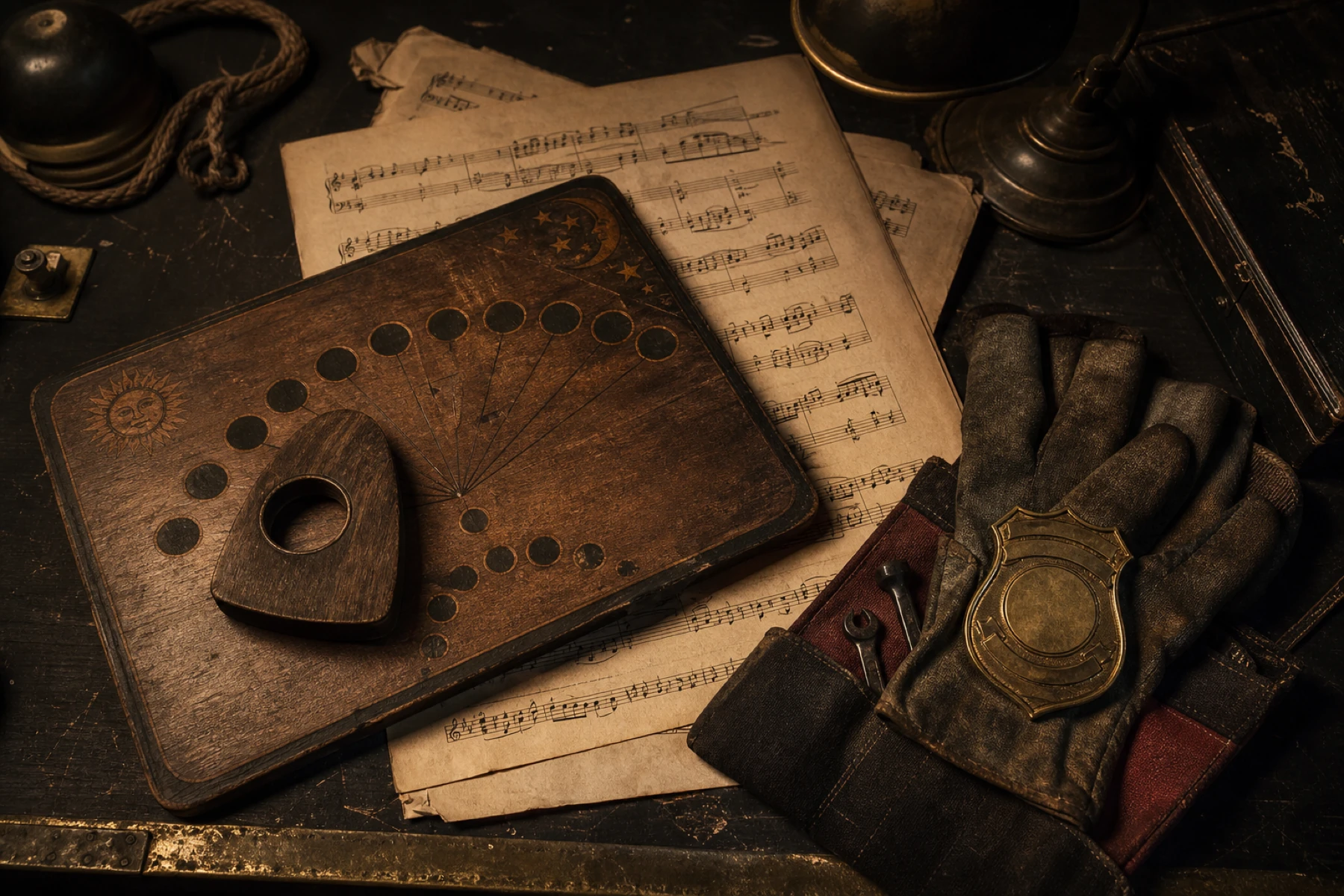
Audiences are remarkably good at recognizing the shape of a story. They know a mysterious object will matter, that a suspicious stranger probably isn’t the murderer, and that if someone is literally named McGuffin, the playwright is probably up to something. The trick works by persuading the audience to lean on those expectations just long enough that they stop asking the better question.
A MacGuffin isn’t defined by what it is. It is defined by what it makes everyone do. The plans, the letters, the statuette, the symphony: the object sets everyone in motion. Nobody actually cares what is inside the briefcase. They care that everyone else is chasing it.
In Overture for an Undertaker, I put Mac McGuffin beside an actual MacGuffin—the sheet music for Beethoven’s forged Tenth Symphony—and for most of the play, the audience assumes the joke stops there. A stagehand named McGuffin, ha, very good, moving on. That is the pun. It is not, however, where the misdirection happens.
The symphony, we learn, has been hidden inside the Ouija board the entire time. But that physical concealment is almost incidental. The board remains in plain view, and the mystery does not turn on whether the audience can guess what is inside it. The more consequential disguise is the identity of the man standing beside it.
That misdirection happens twice after the object has already been hidden, and neither turn depends on where the object is.
First, McGuffin is introduced as exactly what everyone in the room decides he is: a sweaty, resentful, faintly ridiculous stagehand who found something valuable and now wants to be paid for it. The wealthy characters condescend to him. The audience files him as background color—comic relief, not a threat, certainly not a suspect worth watching closely. He is too obvious to be interesting.
Then, at the end of Act One, he produces a badge. He is not a stagehand at all, he tells us; he is undercover police, thirty-three years deep on a sting. This lands as the “real” reveal. The audience recompiles everything. The stagehand was never what he seemed, and now he is the authority figure who will solve the case. He gets to boss the actual detective around for the rest of the play, and the audience lets him, because a badge is a badge.
Act Three reveals that the badge was the misdirection, not the cover story. There is no sting. McGuffin forged the symphony himself, planted the “discovery,” and killed the man who found him out. The badge was not a costume over the truth. It was a second costume over the first one.
McGuffin hides the symphony once. He hides himself twice.
That is the difference worth naming: misdirection through function rather than concealment. The sheet music is physically hidden, but its location is not what carries the deception. What changes is McGuffin’s role—first by inviting the audience to underestimate him, then by inviting them to over-trust him. The audience is not simply pointed toward the wrong object. It is persuaded to trust the wrong person twice, using two different kinds of evidence: first a job that seems too small to matter, then a badge that seems too official to question.
I return to the same kind of misdirection in The Case of the Black Velvet Notebook. Lieutenant Cleftjaw tells the room that nobody changes seats, switches drinks, or touches anything. The audience hears a police officer imposing order. Brick eventually realizes that the instructions were not security at all; they were choreography, ensuring that Cordelia would be led to one exact chair, at one exact table, with one exact glass. The clue was spoken aloud. The audience had simply assigned it the wrong function. Brick calls it “a confession wearing a badge.”
In Overture for an Undertaker, the Ouija board hides the score, but the badge hides the man. One concealment protects the evidence. The other persuades the room to stop questioning the person who controls it.
Sometimes the MacGuffin is the thing everyone chases.
Sometimes it is the authority that tells them to stop looking.