Bert Furioli and I met in undergraduate school and spent years writing sketch comedy together before either of us had written a word of mystery theatre. Our first collaboration for Mystery Theatre Unlimited was Slay Ride, or Rudolph the Dead-Nosed Reindeer, born out of impatience rather than ambition. We’d been handed a script from our then-parent company that was bad enough we were certain we could write something better, and we proved it in a week, expanding an older sketch of ours into a full show. That’s the whole origin of the partnership that produced fifty-two shows for MTU between 1996 and Bert’s death in 2025: two guys who thought a script could be fixed fast, and were right often enough to keep doing it for thirty years.
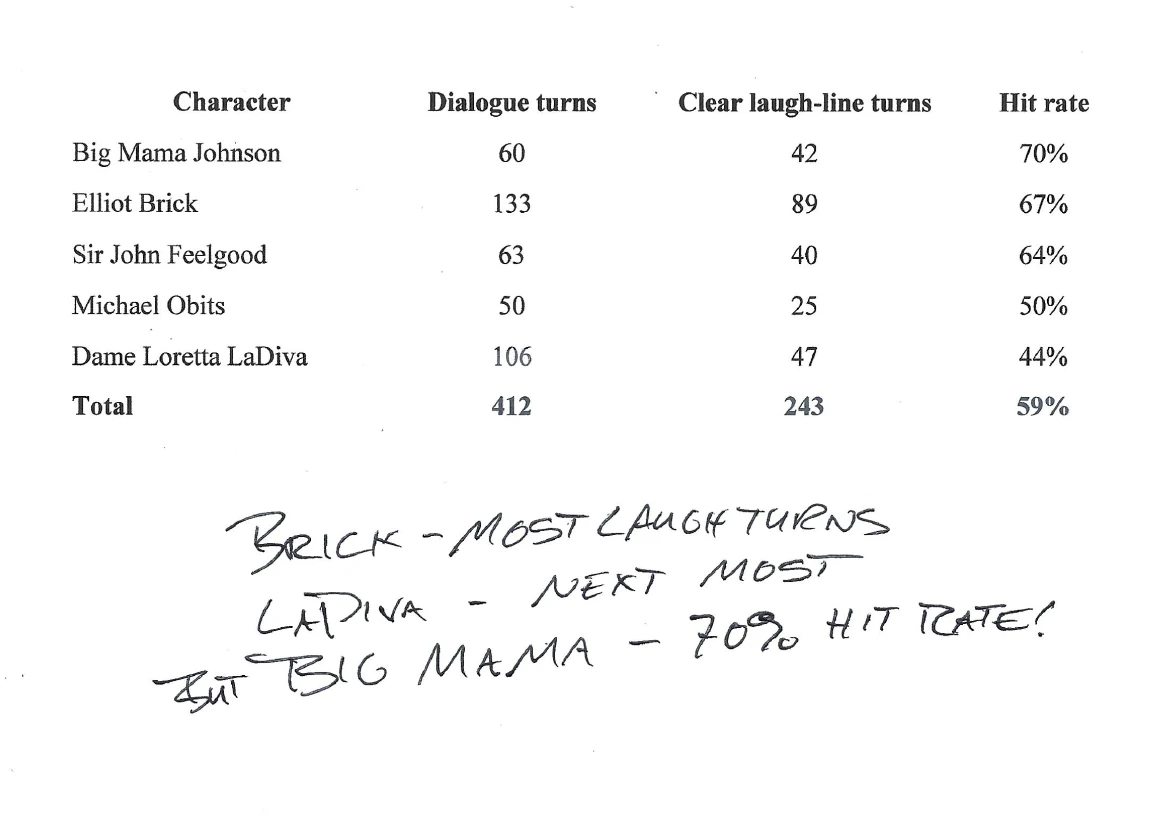
For thirty years, that rule was the engine of Mystery Theatre Unlimited. It’s why a three-hour dinner show never went slack, why an audience mid-entrée could stay locked in through a stretch of exposition, why even our weakest scripts kept a room laughing. Bert wasn’t wrong about what an audience needs. He built shows the way a drummer builds a groove—steady, relentless, exactly as funny in minute forty as it was in minute four.
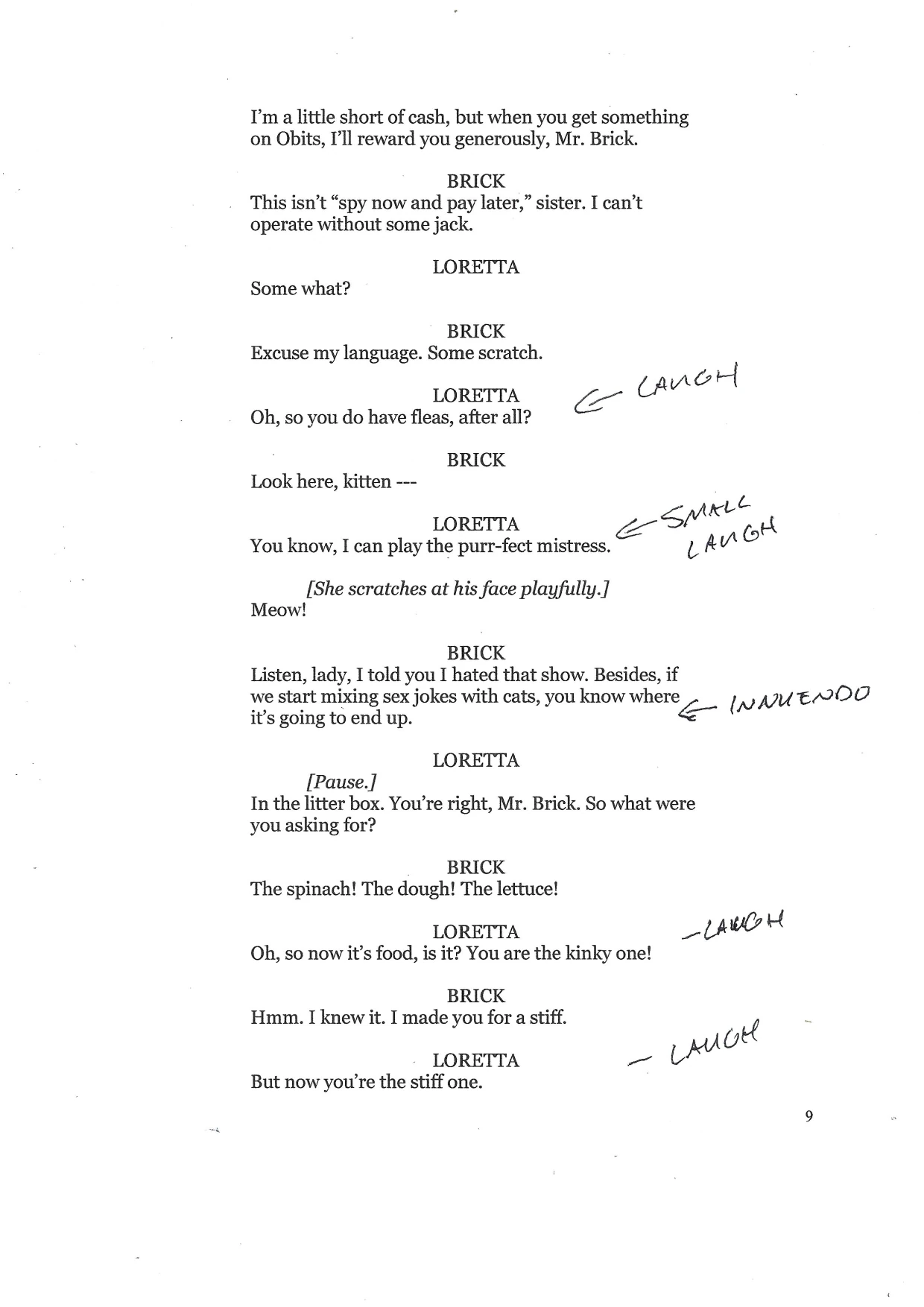
My job in the partnership was different. While Bert was counting laughs, I was trying to make sure the thing added up—that a killer we hadn’t chosen yet would, eventually, make sense retroactively, that a clue dropped in Act One would mean something in Act Three, that the audience’s Detective Cards were reasoning and not just guesses. Bert and I often didn’t know who the killer was until close to opening. We were writing something closer to a string of connected sketches than a puzzle with an answer key, and my role was to go back through afterward and stitch a solution onto whatever we’d built.
That approach produces something. It rarely produces a fully clue-driven mystery.
Take Overture for an Undertaker, one of our earliest Elliot Brick scripts. Four suspects, ninety minutes of first-rate Bert material—the running gag of Beerstein’s pomposity, Tammy Cash’s stupefied lottery joy, endless mileage out of “Wheeling” as a pun. And when it comes time to solve it? A Ouija board tells us who did it. A prop consulted like an oracle, because we needed an ending and the joke rate had used up the runway we’d have needed to plant one properly. It works in the room because the audience is laughing too hard to notice they were never actually invited to solve anything. It’s a farce wearing a mystery’s clothes.
You can watch the same compromise happen across the whole run. In The Case of the Maltese Ferret, Brick delivers his Act Three summation and gets interrupted, corrected, contradicted—the real account keeps getting handed to him by the person who actually lived it. That’s a wonderful bit. Miss Scarletta betting twenty dollars that Brick fingers the wrong killer, before he’s said a word, is one of the best jokes in the catalog. Notice what it’s doing structurally, though: It’s a joke that preemptively excuses the mystery from having to work by making Brick’s failure the punchline before the reveal even starts. When your detective is designed from the outset to be wrong, you’ve built yourself an escape hatch from ever having to be fairly clued.
I don’t say any of this to take anything away from those scripts. The joke-per-three-lines rule is why they still work, thirty years later, at a dinner table full of strangers. It meant the two disciplines—comedy and mystery—were competing for the same real estate, and under Bert’s rule, comedy always won the fight.
The Case of the Black Velvet Notebook is the first Brick script I’ve written without that rule pulling against me. I don’t think I could write a script that wasn’t funny if I tried, so this isn’t a story about abandoning jokes. It’s that there was no one in the room counting anymore, no metronome insisting the next laugh arrive by line three whether or not the story was ready for it. The shape got to lead, for once, and I finally got to find out what that looked like.
What it looked like, structurally, was the Act Three sequence with Biff, Lester, Bruno, and Velvet—the first time in the Brick catalog where the elimination is an actual elimination. Biff is cleared by an alibi that costs him something to admit. Lester is cleared because his own fastidiousness is the alibi—“If Lester Callahan planned a murder, there would be a spreadsheet.” Bruno is cleared because his failure mode, watching an empty room at parade rest, is psychologically consistent with a man who lost the thing he was guarding, not a man who took it. Each suspect is dismissed for a reason built into the character on the page, not invented on the spot to clear the runway for the next joke. And the reveal has a second layer underneath it—Velvet didn’t hire Brick to find Cordelia; she hired him to find the notebook—the kind of twist that requires knowing your ending well before Act Three, which is the exact thing Bert and I almost never had.
Here’s the part I don’t want to let myself off the hook for. The comedy in Black Velvet Notebook didn’t get thinner once the joke rate stopped being enforced. It got longer-fused. The apple Brick produces at the top of Act Three isn’t a single joke—it’s a bit that pays off three separate times across the scene, building on itself instead of resetting after each laugh. “Legally, I have to be right at least once per show” isn’t funnier than anything Bert would have written, but it’s doing something Bert’s rule would never have had the patience for: It’s a joke that only works because of everything that came before it in the play. So maybe the honest version of this reflection isn’t that structure beat comedy. Maybe Bert’s joke rate and my need for things to add up were never actually enemies—they were built for different clocks, his ticking every three lines, mine ticking across three acts, and I only found that out once I was running the clock by myself.
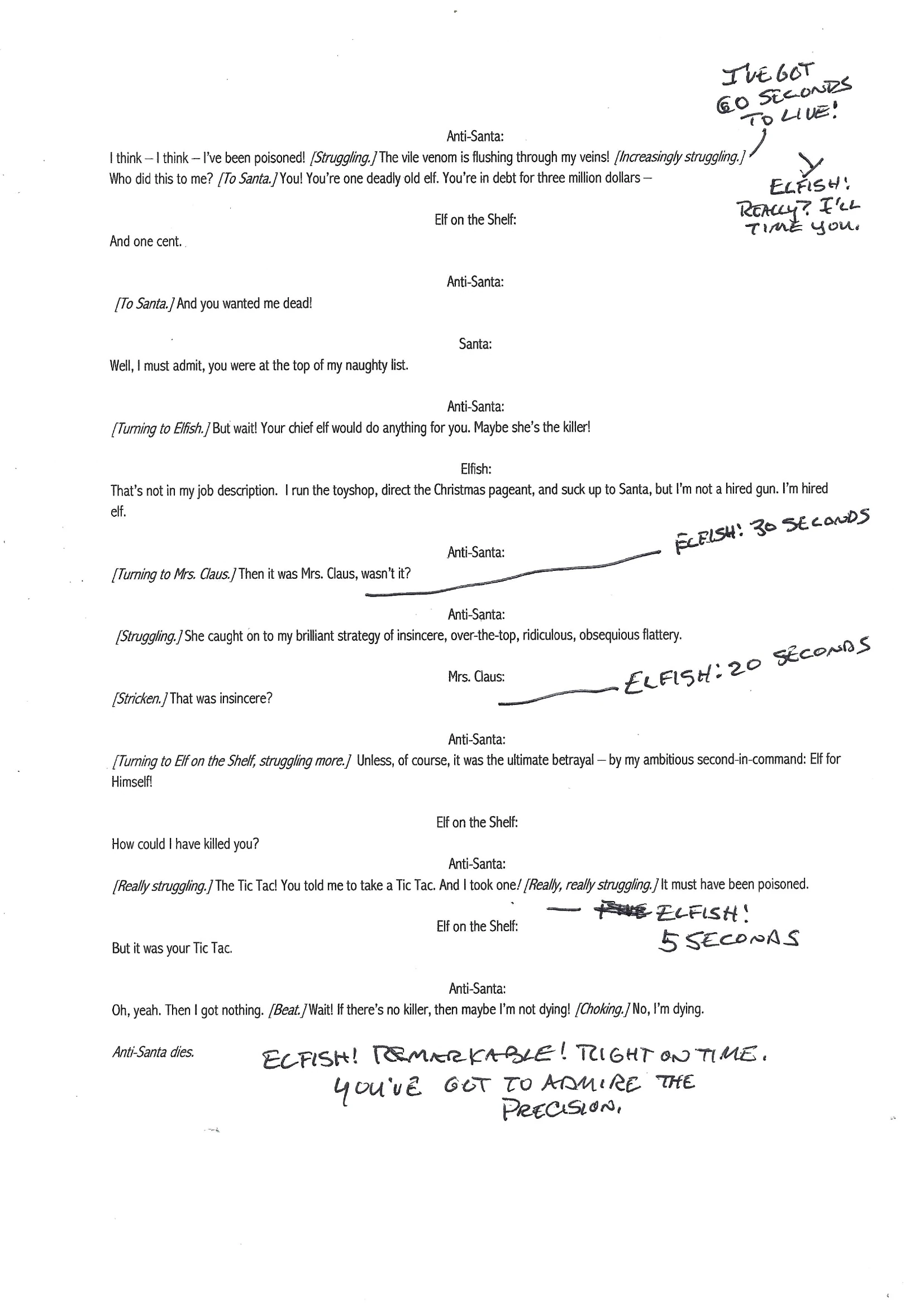
There’s a script page where I timed him.
Not metaphorically. Anti-Santa gets a dying speech—accusing every suspect in the room, one after another—and in rehearsal I stood at the back with a stopwatch and wrote the seconds in the margin as he went. Sixty seconds to live. Thirty. Twenty. Five. He hit every mark. I wrote it right there on the page: Remarkable. Right on time. You’ve got to admire the precision.
Bert counted jokes. I counted seconds. Neither of us was keeping time for its own sake—we were both trying to answer the same question from opposite ends: how much a laugh can carry before the story needs the next thing to happen. His clock ran per line. Mine ran per scene. A stopwatch and a joke count turned out to be the same instrument, aimed at two different problems.
“A stopwatch and a joke count turned out to be the same instrument, aimed at two different problems.”
I’d trade a lot to still be arguing with Bert about which killer we should pick two weeks before opening. He made every script funnier than I would have made it alone. I was always the one holding the structure together; that was my discipline, learned and reinforced over fifty-two shows. Bert’s counting was its own kind of discipline, tuned to a shorter clock than mine, and for thirty years the two clocks running at once are what got a show out the door on schedule and into a laughing room.
Black Velvet Notebook is the mystery I always wanted to write. It’s also, I suspect, the mystery I only knew how to write because thirty years of a man counting my jokes taught me exactly how much story a laugh can carry before it needs the next one.