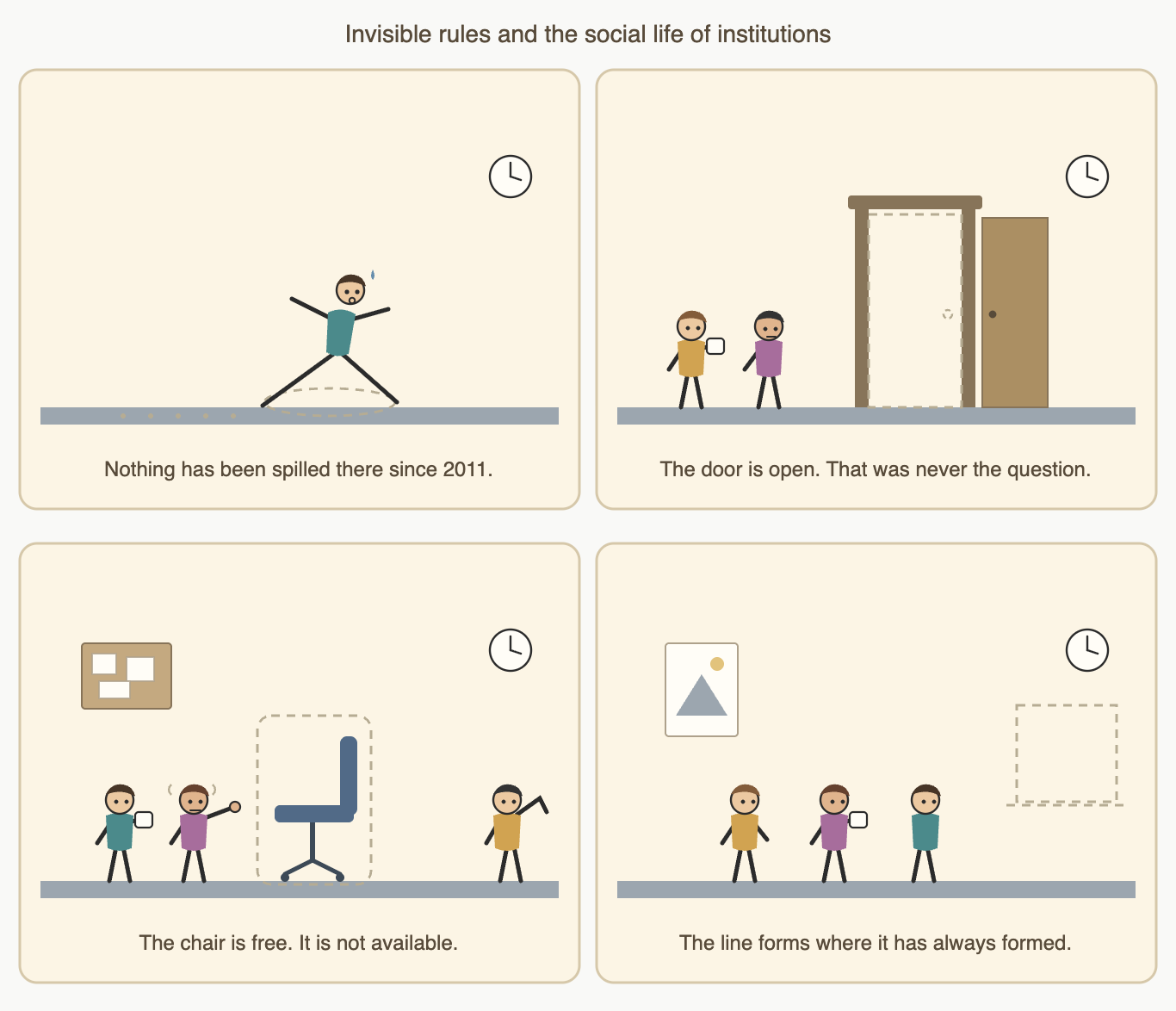
Every institution has two rulebooks: the one on paper and the one people learn by getting in trouble.
The official rulebook is visible, citable, and largely beside the point. It contains what the institution chose to write down, which is rarely what governs daily life.
The unofficial rulebook is where power actually lives: who gets corrected and who gets indulged, which complaints are taken seriously and which disappear, who is permitted eccentricity and who must conform, what everyone knows but nobody says in the meeting.
You don't request this rulebook. You absorb it — usually through a mistake you didn't know you were making until it was already made.
My work returns to institutions — assisted living facilities, rehearsal halls, campaign offices, retreat centers, community theatres, churches — because institutions make invisible rules visible. The pressure of communal life forces the unofficial rulebook into the open. You can watch it operate. And what you can see, you can write.
In Signfeld 2040, Del Boca Vista Phase III runs on invisible rules. The facility guidelines sit in a binder untouched since orientation; the rules that govern daily life are the ones Gerry outlines in his opening monologue: scooter protocol, the courtesy pause, the precise calibration of the hallway nod.
Too much acknowledgment and you're lonely.
Too little and you're hostile.
Wave after passing and you're haunting.
These rules are nowhere recorded. They are enforced with the full social weight of a community that has nothing but time and each other to observe.
Nooman codified a system that was already there.
His laminated complaint forms and triplicate grievances overlay a structure that was already rewarding compliance, punishing visibility, and maintaining hierarchy through minor infractions. Formalizing the system gave him no authority over it. The unofficial system was always more powerful; it only needed him to make it legible.
Comedy excels at exposing invisible rules because it allows characters to over-enforce them.
Nooman can pursue institutional logic to its limit — triplicate filings, cross-referenced grievances, dossiers on food allergies "for safety purposes" — and the audience laughs at behavior that is entirely recognizable, pushed just far enough to be seen clearly. Every institution has a Nooman. Usually several.
Bureaucracy is structurally social theater.
When Nooman files a complaint, he is performing authority more than changing behavior. The form is a prop. The triplicate copies are costume. The filing is a scene. The outcome matters less than the enactment: I am the one who enforces. I am the one who notices.
Everyone else is performing too.
Gorge performs the aggrieved rule-follower, outraged but immobilized.
Eileen performs sophistication while being consistently undone by appetite.
Skrammer performs eccentric genius, gaining license others don't have.
Gerry performs detachment — the observer above it all — while remaining, as Nooman notes, morally adjacent to everything.
The characters believe in their performances; that belief is the mechanism. If it disappeared, the institution would simply find new performers, because the functions are structural: someone enforces, someone violates, someone observes, someone absorbs the consequences.
People perform institutions for one another as surely as they live inside them.
The machinery is the same whether the institution is a pageant rehearsal, a campaign war room, or a corporate retreat center. Only the costumes change.
What matters most is the gap between the official and unofficial rulebooks — the space where stated values and practiced values diverge, and that no one names.
That gap is where the drama lives.
It is where Nooman's speech about culinary freedom collides with the brie in his mouth. Where the retreat center's language of integrity masks the habits it installs. Where permission structures allow speech that cannot be spoken directly — and turn that permission into its own constraint.
The gap reveals the institution in its most honest form.
Every organization runs on managing that gap: what it normalizes, what it permits, what it makes unsayable.
Nooman paid attention to it. That was his real function.
His obsessive triplicate records preserved the full social life of an institution that would have denied it existed.
He was right about the soup rotation. Right about most things.
He just couldn't see that the invisible rules he enforced were the same ones that would eventually kill him.
The social life of institutions, rendered in orthopedic shoes.